Production Scrapers That Actually Deliver

A physics enthusiast who found his calling in solving impossible scraping challenges for D2C brands and lead gen agencies

That kid obsessed with Einstein and Feynman? Now I'm building production scrapers that extract millions of records while bypassing the toughest anti-bot systems. 50+ production systems built. Co-founder @ CubikTech.


Harsh Gawas - Web Scraping Specialist and Co-founder of CubikTech

Trusted by

Workweek Agile Starlly Limited Supply Quordinate AbarAbove

The Unlikely Path to Scraping

From a small town in Goa to building production scrapers that break through the toughest anti-bot systems

01

The Goa Beginning

+

Grew up in a small town in Goa, searching for my passion. Everything changed when a physics teacher ignited my curiosity.

Became obsessed with Einstein, Feynman, and relativity. Read everything from "Einstein's Relativity" to "Life 3.0". Topped my class in math and developed deep physics knowledge.

02

From Physics to Code

+

CS Engineering degree. The problem-solving approach from physics applied perfectly to code.

Failed first startup (MSME aggregator) taught me to solve real problems. Won multiple hackathons — loved breaking down complex systems and finding loopholes.

03

Finding Scraping

+

Co-founded CubikTech. Clients kept asking for "impossible" data extraction.

Breakthrough: Cloudflare-protected hotel data — found API loopholes, forged tokens, built custom decryption. Delivered what seemed impossible.

Scraping = system analysis + creative problem-solving + production engineering.

"We cannot solve our problems with the same thinking we used when we created them." — Albert Einstein This became my approach to scraping. When websites add anti-bot protection, most scrapers try harder with the same methods. I step back, study the system's assumptions, find the loophole. That's how you break through Cloudflare, bypass CAPTCHAs, and build systems that run on itself.

Follow for more scraping breakdowns and D2C automation insights

@HarshGawas25 on X → Connect on LinkedIn →

How I Approach Scraping

The physics mindset applied to breaking through anti-bot systems

Systems Thinking

Every website is a system with assumptions. My job? Find the assumptions, find the loophole.

Example: Most scrapers try to solve CAPTCHAs. I study the authentication flow to find API loopholes. For alltophotels.io, I discovered I could forge tokens directly. No CAPTCHA solving needed.

First Principles

Don't accept "This can't be scraped." Break it down to fundamentals.

Example: Cloudflare blocks traditional scraping. But websites still need to load data for real users. Find how they authenticate real users, replicate that—not the browser automation.

Production Mindset

One-off scripts fail. Production systems need resilience, monitoring, graceful degradation.

Example: The Blinkit scraper kept crashing every 6-8 hours. 3 days of investigation revealed a Docker configuration issue. One line of code (init: true) fixed it—now it runs for 48+ hours without issues.

AI Enhancement

Modern scraping isn't just extraction—it's extraction + enrichment + intelligence.

Example: Scraping ABC licenses is step 1. Using Gemini 2.5 Flash with real-time Google Search grounding to enrich with emails, websites, and business info? That's what turns data into intelligence.

The Reality of Production Scraping

Here's what most agencies won't tell you: Scrapers break. Often. Websites change their structure, update anti-bot systems, rotate authentication methods. If an agency promises "scrapers that never break," they either don't understand production scraping or they're lying.

At scale (20k+ products daily), you're not fighting one website—you're fighting dozens of platforms, each with their own quirks, rate limits, and protection systems. Maintenance isn't a bug, it's the job.

The Real Question Isn't "Will It Break?"

The question is: How fast can I detect the issue, identify the change, and deploy a fix?

  • Monitoring: Real-time alerts when success rates drop
  • Diagnostics: Detailed logs to pinpoint what changed
  • Turnaround: Same-day fixes, not weeks of back-and-forth
  • Communication: Transparent updates on what broke and why

This is why internal dev teams struggle with scraping. It's not just about writing code—it's about proxy rotation expertise, bot protection patterns, and knowing when to pivot from browser automation to API interception. That's the specialized knowledge that separates hobbyist scripts from production systems.

Production-Grade Scraping, Not One-Off Scripts

The technical capabilities that enable reliable, scalable scraping systems

Proxy Rotation Mastery

  • Strategic mix of residential, ISP, and datacenter proxies
  • Official partnerships: BrightData, Geonode, Massive
  • Cost-optimized rotation patterns
  • Advanced anti-detection strategies

Browser Fingerprinting Evasion

  • Selenium Grid with custom configurations
  • Playwright for advanced browser control
  • Automation that mimics human behavior
  • Canvas fingerprinting bypass techniques

CAPTCHA Bypass Techniques

  • Direct URL parameter manipulation
  • Token forgery and session management
  • API-first approaches where possible
  • Strategic timing to avoid triggers

Rate Limiting Intelligence

  • Request timing that mimics humans
  • Adaptive delays based on site response
  • Distributed request patterns
  • Multi-worker parallel processing (1-10 workers)

Background Workers & Message Queues

  • Celery for distributed task orchestration
  • AWS SQS for fault-tolerant message queuing
  • Redis for caching and session management
  • 20k+ products/day with zero manual intervention

Why it matters: Scraping at scale (20k+ products daily) requires job orchestration that survives crashes, handles retries, and distributes work across multiple workers. Message queues ensure no data is lost when scrapers fail.

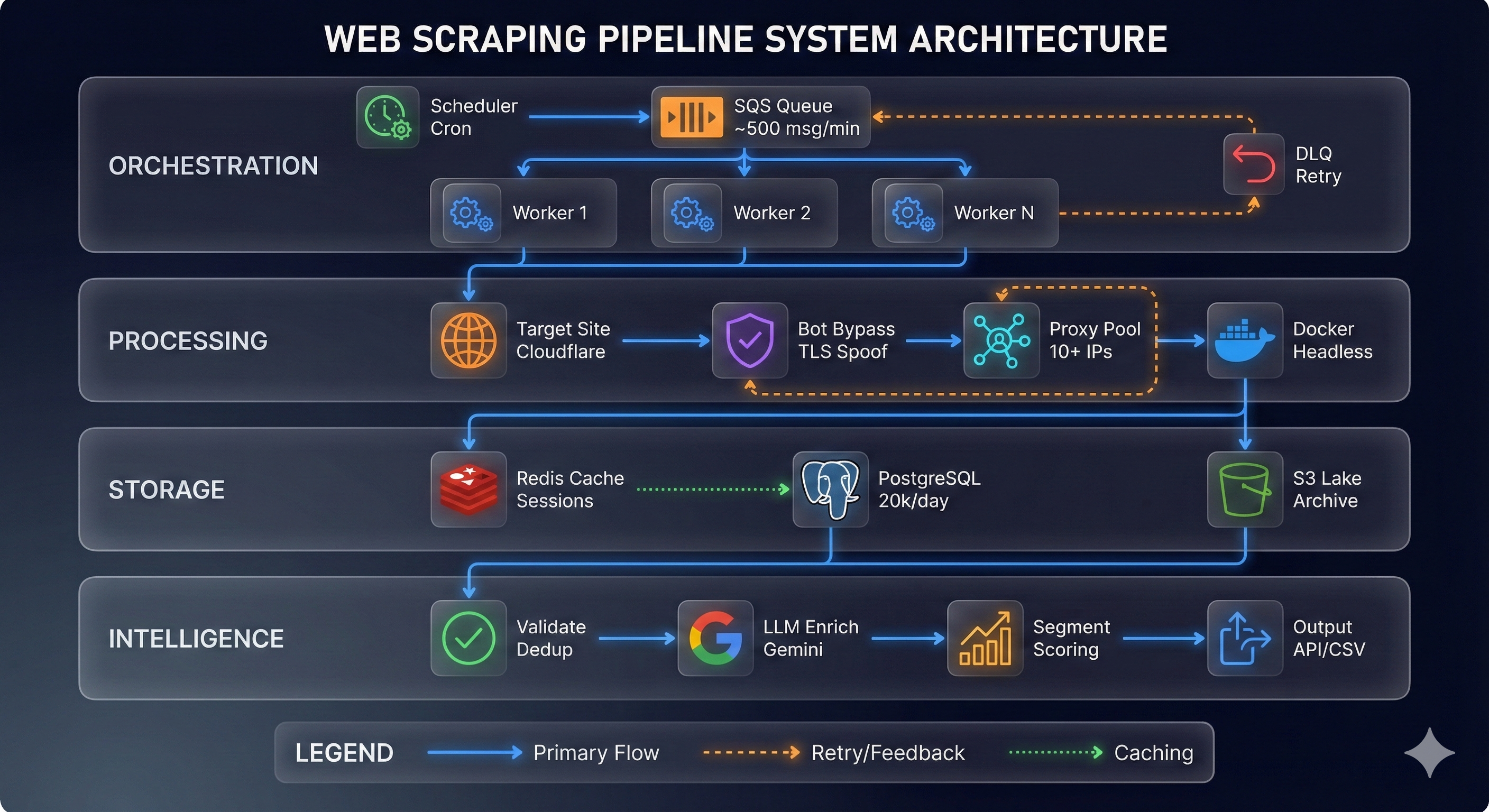
Not Just Scraping. Production-Grade Data Pipelines.

Beyond basic extraction — retry loops, intelligent caching, and AI enrichment that scales to millions of records

Production Scraping Architecture Diagram

Featured Projects

Production-grade scraping systems handling millions of records

Real-Time E-Commerce Intelligence at Scale

Blinkit Production Scraper
Node.js Puppeteer Docker AWS EC2

The Problem: D2C brands lose revenue to stockouts and get undercut by competitors who monitor pricing in real-time. Manual price checking doesn't scale. Most scrapers crash or get blocked.

The Challenge

  • 1,000+ products per location across 50+ cities, 100+ pincodes
  • Cloudflare protection blocking traditional methods
  • Must run 24/7 without supervision
15K+
Products/Hour
99.6%
Success Rate
24/7
Uptime

Key Achievements: API interception (10× faster than HTML parsing), residential proxy integration, batch processing (48× database speedup), full pagination (50 pages per job), 3-6 parallel workers with intelligent job orchestration.

→ Perfect for D2C brands tracking competitor pricing across marketplaces, or agencies building competitive intelligence tools.

Five-Scraper Lead Intelligence Platform

Stack Optimise
FastAPI Selenium Gemini 2.5 BrightData PostgreSQL

The Problem: Lead gen agencies burn 80+ hours/month on manual research: finding licensed businesses, enriching with emails, verifying contacts, categorizing by territory. This doesn't scale.

The Solution: Not One Scraper—A Platform of 5

1. Luxury Venue Discovery

Google Maps scraping (7 endpoints). 9 venue categories. Multi-factor luxury scoring. 89% valid contact data.

2. Hotel Data Scraper

alltophotels.io extraction (the origin story!). Authentication handling, 10+ data points per hotel.

3. Cafe Discovery (Dual Implementation)

Apify + BrightData versions. UK/US targeting. 1-10 parallel workers. Automatic checkpointing.

4. Construction Company Scraper

UK directory scraping. Letter-based batching (A-Z). 500 companies per batch.

5. Facebook Ads Library

800+ ads per brand. ML ensemble (92.7% accuracy). 8 LangGraph agents. Multi-modal analysis.

50+
API Endpoints
85-95%
AI Enhancement
95%
Time Savings
72%
Website Discovery

Impact Stories

  • Compliance teams: 80 hours/month → 4 hours/month
  • Real estate teams: 6-week site selection → 3 days
  • Marketing agencies: 47 premium venues with validated contacts

→ Built for lead gen agencies, GTM teams, and anyone drowning in manual prospect research.

Client: Built for Stack Optimise

From 100 Hours to 4 Hours: Lead Gen on Autopilot

AbarAbove Lead Automation

The Problem: AbarAbove.com (bar accessories D2C brand) was manually researching 50 leads/week. Each lead took 30+ minutes: Find ABC license → Find business → Find contact info → Verify → Add to CRM. 100+ hours/month of pure manual work.

The Solution: n8n Workflow Automation

  1. Auto-scrape California ABC license database (daily)
  2. Hunter.io email enrichment (batch processing)
  3. Multi-stage email verification
  4. Categorize by territory/license type
  5. Route to Google Sheets CRM
10x
Volume Increase
85%
Email Accuracy
96%
Time Saved
24/7
Autonomous

The Result

  • 50 leads/week → 500 leads/day (10x volume)
  • 85% verified email accuracy
  • 100+ hours/month → 4 hours/month (just reviewing automated results)
  • Runs 24/7 - fully autonomous
Built for: D2C brands doing B2B outreach, or agencies managing lead gen for clients
n8n Workflows Hunter.io API ABC License Database Email Verification Google Sheets

Industries & Data Types I Specialize In

Deep domain expertise in the data challenges that matter to D2C brands, lead gen agencies, and GTM teams

🛒

E-Commerce & Quick-Commerce

Real-time intelligence for D2C brands competing on fast-moving marketplaces

  • Marketplace data (Blinkit, Zepto, Amazon)
  • Competitor pricing/availability tracking
  • Product catalog monitoring
  • Real-time inventory intelligence
🎯

Lead Generation

Transform manual prospect research into automated intelligence pipelines

  • Government databases (ABC licenses, registrations)
  • Contact enrichment (emails, phones, websites)
  • Territory mapping & categorization
  • B2B prospect discovery at scale
🔍

Competitive Intelligence

Monitor competitor moves before your competitors monitor yours

  • Facebook Ads Library scraping
  • Marketing campaign analysis
  • Brand positioning monitoring
  • Pricing strategy tracking
📍

Local Business Data

Hyperlocal intelligence for site selection and market analysis

  • Google Maps extraction (any location)
  • Luxury venue discovery & scoring
  • Multi-location business tracking
  • Review/rating aggregation

Production-Grade Scraping, Not One-Off Scripts

The difference between scrapers that break in production and systems that run for months without supervision

One-off scripts - Works once, breaks tomorrow
Docker containerization with proper init (tini for zombie process handling)
Manual restarts - Crashes require intervention
Auto-recovery + monitoring - Graceful degradation and job recovery
No proxy management - Gets blocked instantly
Multi-provider rotation - BrightData, Geonode, Massive partnerships
HTML parsing only - Fragile, breaks on UI changes
API interception first - Find the backend calls, bypass the UI
Crashes on rate limits - No resilience strategy
Adaptive delays + graceful degradation - Human-mimicking patterns
No data enrichment - Raw extraction only
Real-time AI enhancement - Gemini 2.5 Flash with Google Search grounding

💡 The Blinkit Stability Lesson

Production scrapers need more than good code. They need robust infrastructure, monitoring, automatic recovery, and systems that run on themselves.

My Blinkit scraper kept crashing every 6-8 hours. The scraping logic was perfect—the issue was how Docker handled background browser processes. One configuration change (init: true) fixed the cleanup issue, turning 6-hour crashes into 48+ hour continuous runs.

The takeaway: When something breaks, dig deep into how the entire system works—not just your code. Understand the platform's behavior, find where it falls short, and work around it. That's the physics approach to scraping.

Dealing with similar production challenges? DM me on X to discuss your approach.

@HarshGawas25 →

Tech Stack & Expertise

Scraping Technologies

Selenium Grid Playwright Puppeteer BeautifulSoup httpx aiohttp undetected-chromedriver

AI Enhancement

Google Gemini 2.5 Flash Claude AI GPT-4 LangGraph CLIP PyTorch

Proxy Infrastructure

BrightData Geonode Massive Proxy Residential ISP Datacenter

Backend & Infrastructure

FastAPI Node.js Docker PostgreSQL Redis AWS EC2 Supabase

How It Works

From discovery to deployment — a proven 4-step process

Discovery Call

Understand your data needs and assess target complexity

Technical Assessment

Analyze architecture, anti-bot protection, and find loopholes

Build & Deploy

Custom development, proxy setup, and production deployment

Ongoing Support

Monitoring, adaptation, and continuous optimization

Beyond Scraping: CubikTech

I co-founded CubikTech, an AI-first automation agency for D2C brands. While scraping is my specialty, we also build broader automation solutions.

🤖
AI Agents

Customer support, operations automation, intelligent workflows

⚙️
Workflow Automation

n8n, Make, custom APIs - automate repetitive ops

📊
D2C Analytics

Custom dashboards, reconciliation, marketplace insights

🚀
MVP Development

90-day delivery for funded startups using AI tools

If your challenge is broader than data extraction, let's talk about what AI automation can do for your business.

Visit CubikTech → Email: harsh@cubiktech.com

Have a Scraping Challenge? Let's Chat.

No pitch, no commitment. Just a conversation about what's possible and how production scraping actually works.

DM on X Connect on LinkedIn

Book Your Discovery Call